Our Favorite Teacher Series
Howard Zinn taught at Spelman College and Boston University where he had an extraordinary influence on his students’ understanding of history and their role in the world. The “Howard Zinn: Our Favorite Teacher” series highlights Zinn’s lasting impact as a professor.Bill Goodfellow’s Reflection
Howard Zinn changed my life!
I went to high school at Mercersburg Academy, a conservative boys’ boarding school in Pennsylvania, the same school my Republican father and uncle had attended.
My father’s sister, Charlotte Goodfellow, was the only enlightened progressive in my family, and she made it her mission to rescue me from her conservative brothers.
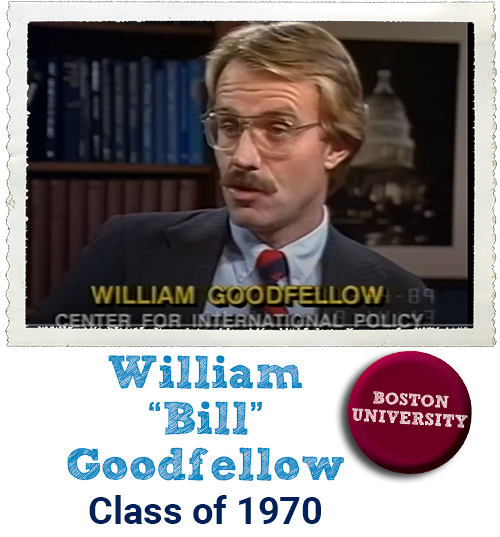
My aunt was chair of the classics department at Wellesley and was an acquaintance of Howard’s. She urged me to register for one of his classes when I arrived at Boston University as a freshman in the fall of 1966.
Howard soon became my academic advisor, mentor, and lifelong friend. He was an amazing teacher, but more than that, he was a proselytizer.
I took every course Howard taught at BU. Most days, a group of us would sit at a big round table with him at lunch in the student union. Howard made sure we went to every anti-war demonstration in Boston, where he often was one of the speakers. He also encouraged us to go down to Washington for big national anti-war demonstrations.
As I was about to graduate from Boston University in 1970, Howard asked if I was applying to graduate school. I told him I was too wrapped up in activist politics to take time out for grad school. He replied, “After the revolution, we will still need people with a graduate education,” and encouraged me to do an MA at the Cambridge-Goddard Graduate School for Social Change, where I enrolled in the Southeast Asian Studies program chaired by Dr. Cynthia Fredrick. She was an old friend of Howard’s, who spoke to our class, and of course we read his book, Vietnam: The Logic of Withdrawal.
I completed my MA and moved to Washington, D.C. in January 1973 to take a job as the research director at the Indochina Resource Center, an anti-war think tank founded by Fred Branfman, a charismatic activist who had exposed the secret U.S. bombing of the Plain of Jars in Laos.
Shortly after hiring me, Fred departed for Southeast Asia in what turned out to be a six-month trip and left me in charge of the organization. Within a few weeks, I received a call from the comptroller of the Women’s Division of the United Methodist Church, our fiscal sponsor, informing me that we were out of money and would have to close. Fred had never mentioned funding, and I assumed that being sponsored by the Methodists meant that every Sunday, when a parishioner dropped a dollar in the collection plate, a tiny portion went to support our work. Turned out we had to raise the money ourselves, and then the donors got a tax deduction from the church. I received a crash course in fundraising from Cora Weiss, a friend of Howard’s who was a legendary anti-war activist and philanthropist.
I spent the last six months of the war in Indochina and departed Phnom Penh in the final helicopter evacuation on April 12, 1975. I returned to Saigon and was evacuated once again at the end of April.
In January 1976, Graham Martin, the last U.S. ambassador to South Vietnam, was asked at a congressional hearing why he thought the South had lost the war. He said that the U.S. war effort had been undermined by “the most effective propaganda campaign the world has ever known.” He singled out the Indochina Resource Center by saying, “This is an enormously effective organization and I do think that they deserve the compliment that I have paid them.”
I returned to Washington, D.C. in May of 1975, an anti-war activist at a moment when there was no longer a U.S. war to oppose. With two colleagues from the anti-war movement, we founded the Center for International Policy with the goal of making sure the lessons of the Vietnam War that Howard had taught us were not forgotten.
I ran the center for 42 years and stepped down as executive director at the end of 2017, although I am on the advisory board and continue to help with fundraising. Fifty years later, the Center for International Policy is going strong and the mistakes and imperial hubris that got us into Vietnam continue to drive U.S. policy. If Howard were with us, he would agree that there is still much to be done.
I now run a tiny NGO called the Afghanistan Peace Campaign, which we set up in 2011 to build public support for a negotiated peace settlement to end the war in Afghanistan. However, members of the U.S.-backed government, and their corporate backers, were making so much money from the war that they had no incentive to end it, while the Taliban were convinced that if they kept fighting, they would eventually prevail.
In 1977, I established the Indochina Project at the Center for International Policy to begin to build public support for the eventual rapprochement with Vietnam and the reestablishment of full diplomatic relations. It took almost two decades, but in 1994 the U.S ended its trade embargo, diplomatic relations were reestablished in 1995, and today Vietnam is a potential ally of the United States. It is our hope that the citizens of United States and Afghanistan will choose peaceful means to resolve their differences and someday will become allies.
I love the life I have lived and owe so much to Howard for opening my eyes and giving my life purpose. I entered Boston University as an economics major, but after taking my first course with Howard, I switched to political science. Had it not been for him, I probably would have become an unhappy banker in Philadelphia!
C-SPAN: Events in El Salvador
November 24, 1989 • William Goodfellow of the Center for International Policy takes viewer calls about current events in El Salvador.

Howard Zinn taught at Spelman College and Boston University where he had an extraordinary influence on his students’ understanding of history and their role in the world. This series highlights Zinn’s lasting impact as a professor. Read more stories and submit your own.